🧠 Rewiring the stories you tell yourself
What neuroplasticity really means
You have heard the word before. Maybe on a podcast, maybe from a friend who swears it changed her life. Neuroplasticity. It sounds big and a little magical. It is neither. It is just the plain fact that your brain changes with use, and it keeps doing that your whole life.
Let's take the hype out and look at what is really there.
What the word means
Your brain is made of cells called neurons. They talk to each other across tiny gaps. When two neurons fire together often, the link between them gets stronger. When a link goes unused, it fades.
That is the whole idea. Neuroplasticity is your brain's ability to change its connections based on what you do, think, and practice. "Plastic" here does not mean fake. It means shapeable, able to take a new form.
This is why you can learn to drive, then one day drive home without thinking about it. The path got worn in. It is also why a song from childhood can come back in full after thirty years. Some paths stay deep.
It happens across your whole life
For a long time, people believed the brain set like concrete after childhood. That turned out to be wrong.
Adults learn new languages. Adults learn instruments. People who lose sight can get sharper at hearing and touch, because the brain reassigns space to the senses still in use. Taxi drivers who memorize a huge city show measurable changes in the brain region tied to spatial memory.
So the door does not close at eighteen, or forty, or seventy. It does get a little slower and stiffer with age, the way the rest of you does. But it stays open. That matters for this course, because the stories you tell yourself are also worn-in paths. If paths can change, stories can too.
What the research shows clearly
Here is the honest part. Some of this is solid, and some of it is thin.
What is solid:
- Practice changes the brain. Repeat a skill, and the brain regions behind that skill grow more efficient. This shows up in careful studies with musicians, athletes, and people learning new tasks.
- The brain can reroute after injury, especially with steady rehabilitation. This is slow, hard work, but it is real.
- Attention matters. The brain changes more around what you focus on, not what just happens in the background.
So the broad claim, the brain changes with use across a lifetime, is well supported.
Where it gets thin
Now the careful part.
Neuroplasticity is often oversold. You may see products or programs promising they can rewire your brain in a weekend, erase old habits, or boost your IQ with a few games. Be slow to trust those.
- Brain-training apps mostly make you better at the app. The proof that they improve daily life, memory, or focus beyond the game is weak.
- Change is usually slow and specific. You get better at the exact thing you practice, and the gains spread less than ads suggest.
- "Rewiring" is a metaphor. It is a useful one, and we will use it in this course. But no single practice flips a switch in your head. What you are really doing is strengthening some paths through steady use and letting others quiet down.
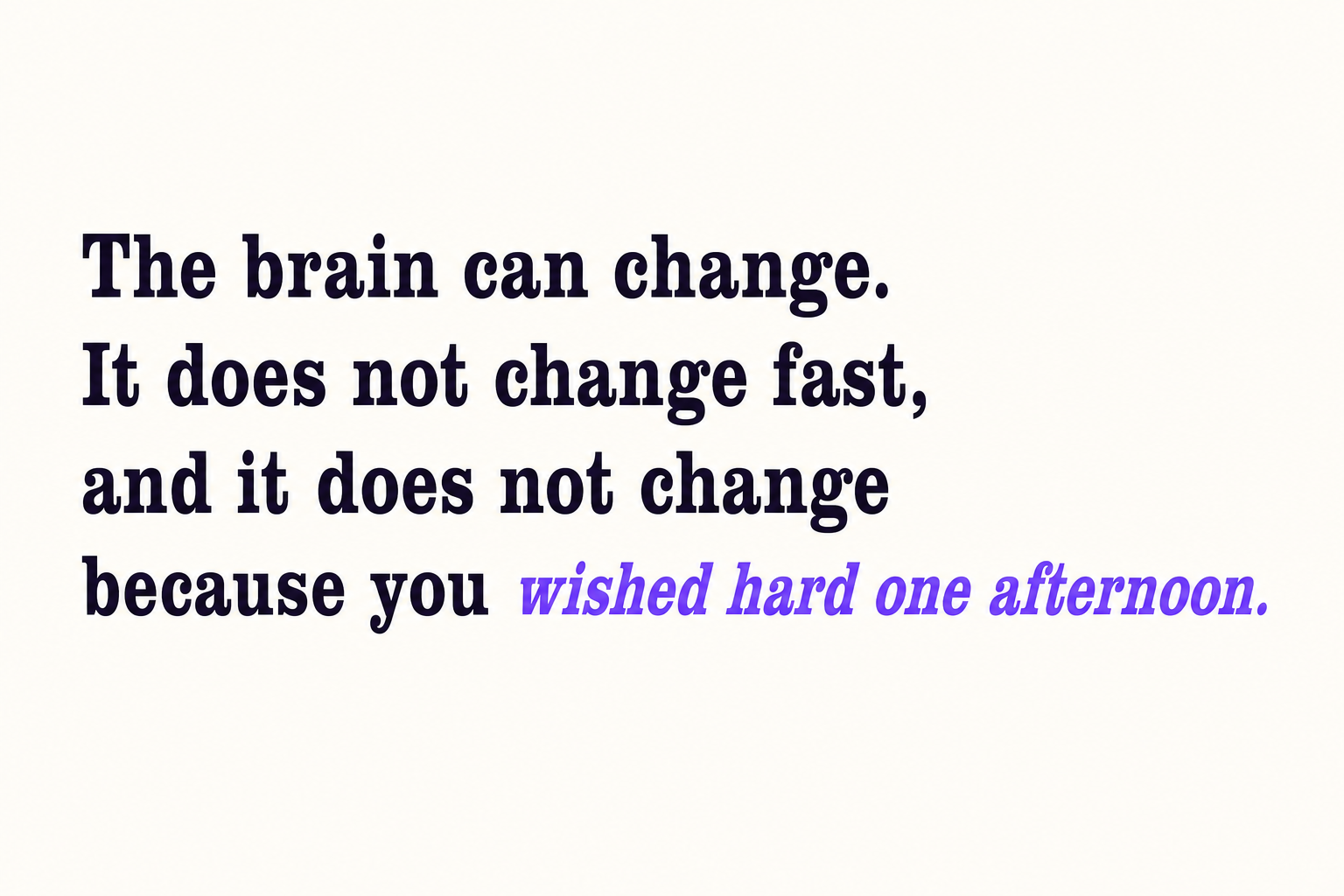
Holding both truths keeps you honest with yourself. The brain can change. It does not change fast, and it does not change because you wished hard one afternoon. It changes because you practiced, a little, again and again.
Why this is good news anyway
Slow and specific is not a letdown. It is a plan.
It means small daily practice is the real engine, not some rare burst of willpower. It means you do not need to be young, or gifted, or starting from scratch. You need reps. You need to point your attention at what you want to strengthen, and return to it tomorrow.
The stories you carry got strong the same way. Repeated. Reinforced. Returned to. You can use that same machinery on purpose now.
A practice to try today
Pick one small thing your brain already does on autopilot. Maybe the thought "I'm bad at this" when you try something new. Maybe reaching for your phone the second you feel bored.
Just notice it once today. Do not fight it, do not fix it. Say to yourself, quietly, "There's that path again."
That is it. Noticing is the first rep. You cannot change a path you cannot see. Before you can relearn a story, you have to catch it running.
Take what fits and leave the rest. We will build from here.